Thursday, February 6, 2014

Read.

Bismillahrrahmanirrahim,

Assalamualaikum.

Just now, I logged on to Facebook and saw a post on The Guardian shared by Wardina Safiyyah Official Page. I was intrigued by the title of the post : Neil Gaiman : Why our future depends on libraries, reading and daydreaming Since I love going to what most people call boring places : libraries and museums, I love to read fictions and I love to daydream and imagine living in the fiction world, I thoroughly read the post and found these words at the end of the post :

"Albert Einstein was asked once how we could make our children intelligent. His reply was both simple and wise. "If you want your children to be intelligent," he said, "read them fairy tales. If you want them to be more intelligent, read them more fairy tales." He understood the value of reading, and of imagining. I hope we can give our children a world in which they will read, and be read to, and imagine, and understand. "

Upon reading those words, I read the words written by Wardina Safiyyah as caption to the post she shared :

"If you love your children please, PLEASE limit the ipad and gadgets. It changes their brain connections.... it doesn't help speech development...motor development... reading ability...I can list many more negative effects. There's no rush. Menyedihkan melihat ketagihan ipad... overseas there are already centres to help children who are addicted. It is and will be a serious problem the future. wallahualam."

Malaysians widely know Wardina Safiyyah as an exemplary mother who nurtured her children to read a lot and teach them on Islamic based values. After reading her caption and the post by Neil Gaiman, I couldn't agree more that parents nowadays are taking the easy way to educate their children. They let the children play games on Ipad and computers because there are claims that the games can develop the children's brain. They let their small children watch TV the whole day just because there are tutor TV and so on that could help them in their studies. They prefer letting the technologies do the 'educating tasks' that should have been theirs. 

I am not yet a mother but I have seen many children with bad behaviours. Children are supposed to be playful and naughty a bit. But these playfulness are different with bad behaviours. There are researches done and proven how technologies that are exposed too early can influence the children to behave badly. In the early ages, the children's brain are like sponges. They 'absorb', process and remember what they see, hear and feel. It is important to nurture the children carefully in the early ages. Nurture their love and passion to reading in the early 10 years of life and InsyaAllah, after that, they will love to read, unforcefuly. 

The importance of reading may seem to be petty and trivial and some parents might feel that it is probably too early to teach their children how to read at the age of three or four. Most parents would think the age six would be most appropriate to teach the children since most children starts their schooling years at the age of six. WRONG ! It is never too early to teach children to read. I once read my father's journal. It was a journal he made to monitor his children's developments. Since I am the first child, mine was the most complete and the most detailed. (He noted my ages when I started grow my first teeth,my first step,my first word, my first time knowing alphabets, my first time reading, my first time gong to school, etc). I was taught to read by my parents (who are teachers) as soon as I started to utter words and at the age of five, I could read Malay story books smoothly without having my parents to help me pronouncing the words,I could read English storybooks, open up dictionaries to look for words I don't understand and scribble the meaning of the words on the book. 

Most people would say, "Yes, of course. Your parents are both teachers. For sure they know how to teach their children." Well, yes. But, in my opinion, all parents are their children's first teachers. To teach them how to eat, how to tie their shoes, how to read, how to pray, how to recite the Qur'an. It is the parent's job and responsibility to teach and educate the children. Just because there are teachers, the parents cannot simply abandon their responsibility to teach the children and solely let the teachers do the teaching part.

Reading is the door to imagining and imagination is the door to take you to places and inventing great things. If Thomas Edison never imagined the 'bulb' that can create light in the night, we might still living in darkness every night. TV, ipad, computer and video games restrict the children's imagination. Instead, the words narrated in fictions, with correct punctuation, use of words and narration, the children will be able to use their imagination and create their own imaginative world, see and feel things. Even the first word Allah delivered to human is 'IQRA' which means 'read'. Islam has acknowledge the importance of reading but still, many finds it boring and tiring. 

So please, let the children read, instead of giving them ipads. Bring the children to libraries instead of going to malls. Without love to reading, the children presumably be less literate and less numerate than we are. They will be less able to navigate the world and to understand it to solve problems.


"Books are the way that we communicate with the dead. The way that we learn lessons from those who are no longer with us, that humanity has built on itself, progressed, made knowledge incremental rather than something that has to be relearned, over and over. There are tales that are older than most countries, tales that have long outlasted the cultures and the buildings in which they were first told." -Neil Gaiman

Sunday, January 5, 2014

Dreams

Bismillahirrahmanirrahim,

Assalamualaikum w.b.t

I had a weird dream last night. I was on a world that is 247degrees different from the world I am living in. In the world, I was kind of like a normal me. There was green field and red sky. Also, there was a weird animal. The front was like platypus. With the head, the beak and the neck. But the body was like hippopotamus, with the feathers on top of the body, like shuttle-cock. I had a fight with that animal. After I killed the animal,  was brought to this shopping mall I guess. The ceiling was made from glass, almost Hogwarts-like. 

Then, there was a lot of dresses and sweat-shirts. The sweat-shirts are mostly white and black. There was many colourful dresses but I saw a black-purple dress and was deeply attached to it. I wanted to buy the dress but I couldn't since I don't have the money that is used in that place. But there is a small ATM next to the shop. I had to use my ID Card to withdraw the money and all the money was shilling. After I finished paying for the dress, I wanted to go out from the mall. But all the door was closed and I had to jump from the third floor and fight some giants, elfs and I also remembered a fairy. And so was it, I couldn't remember the rest of the dreams.

This whole day, I had my mind all over the dream and I keep on repeating what I saw in my dream. Well, I am a person who couldn't live with all the curiosity. So, I had to made my own little research as usual. I read about how dreams are formed, why people dreams, and a few other facts about dreaming. So, before we move on about dream. We have to first, understand 'sleep' and brain condition during our sleep.

So, basically, when we sleep, we have to go through 5 stages of sleep. The first stage is the light sleep where the muscles started to relax. At this stage, it is easy to wake up. On the second stage, the heartbeat and breathing rate starts to decrease slowly and a person enters a calming phase at this stage. At third stage, the brain starts to generate slow delta waves and the person falls into deep sleep. At this stage, the brain starts to organize info, data and memories of the day. The fourth stage is when the person is in really deep sleep and full rest. The brain starts to produce delta waves and breathing becomes rhythmical and stable. The fifth stage is the stage where dreams are formed. The brain waves speed up at this stage and muscles are temporarily paralyzed. Heartbeat and breathing rate increases. Rapid eye movement (REM) occurs at this stage.

The sleeping stages

Scientist and researches believe that a person goes through the five stages of sleeping repeatedly when they are sleeping. The sleep during the fifth stage is called the REM sleep while the other four stages are called the (No Rapid Eye Movement) NREM sleep. REM was first discovered  in 1953, when researchers first described REM in sleeping infants. Studies about sleep and dreams was considered absurd at the time. When they realized that there are strange, illogical experiences we call dreams that happened during REM sleep, they start to carefully observe this phenomenon. Studies were also conducted on mammals and birds where it was found that they show signs of REM sleep while the reptiles and cold-blooded animals don't. This concludes that mammals and birds most probably dream in their sleep too.

REM sleep begins when the area at the base of the brain send brain waves to the thalamus, cerebral cortex and spinal cord. The signals order the spinal cord to shut off all neurons in the spinal cord and causes temporary paralysis in the muscles. This is the natural reaction to prevent a person from acting out their dreams. (If the muscles are not paralyzed, people who dream about playing football most probably be kicking his bedmate all night long.)

Believe it or not, REM sleep actually stimulates the brain region that is used to learn. Cerebral cortex (refer the paragraph before) is the region of the brain that is used for thinking, learning and organizing information. This is probably the reason why sleep is so important in daily life. People who are lacking of REM sleep usually have difficulties to recall what they have learn. Some scientists also believe that during the sleep, the cortex is organizing the information that it receive during the day and in the attempt to do so, it creates a 'story' out of the fragmented brain activities.

The story are the dreams that the person is having. Some dreams are incorporated with the memory, the thoughts and some are just the mere fantasy that the brain created. The visual dreams, as in what we see in the dreams are basically what we have seen, or at least what we hope to see. The blind people do not have visual dreams. They usually dream of things they touched, heard and feel. Researchers also believe that more negative emotions are portrayed in the dreams, such as fear, anger and frustration. Dreams that comes with the positive emotions are usually the fantasy dreams in colours. Dreams that portrays negative emotions are usually in black and white or dull colours.

People dreams more that five times when they sleep but they usually forgets their dreams because the part of the brain that is used to memorized is inactive during the sleep. People who have accustom themselves to recall their dreams as soon as they wake up have tendency to remember their dreams. They could also remember details and colours in their dreams and this is said to have association with their creativity and imagination. People with creative minds tend to remember their dreams more vividly because their dreams are usually weird and out of the world with lots of colours and different things that what they have seen all day. :)


source:
http://www.ninds.nih.gov/disorders/brain_basics/understanding_sleep.htm
http://science.howstuffworks.com/life/inside-the-mind/human-brain/dream2.htm
http://psychology.about.com/od/statesofconsciousness/tp/facts-about-dreams.htm
http://curiosity.discovery.com/question/dream-in-color

Sunday, April 28, 2013

Academic Visit - Joining Program


Bismillahirrahmanirrahim,

Assalamualaikum,

A joining program was organized between Sekolah Menengah Kebangsaan Agama Wataniah (SMKAWA), Alor Keladi, Besut and Faculty of Languages and Communication (FALCOM), Universiti Sultan Zainal Abidin, Kampus Gong Badak. This joining program was organized by the semester two students of Bachelor in English with Communication (BEN). This program is a continuous program between FALCOM and SMKAWA. The first activity of this joining program is the Academic Visit (AV) of 53 students and 3 teachers of SMKAWA on Tuesday, 23rd April 2013 where the students and the teachers of SMKAWA visited UniSZA and throughout the visit, the students will use English fully as the medium of communication. The group arrived at the campus at 9.30 am.  


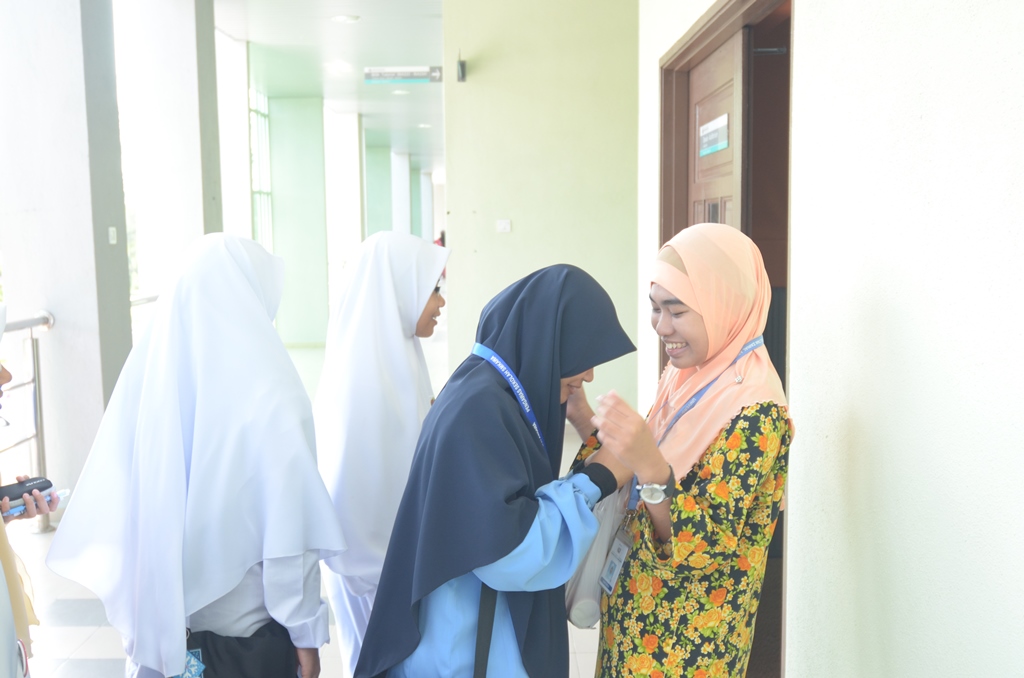
The arrival..


Being greeted by the Committee Members


After the arrival of the Dean of Faculty of Languages of Communication, Puan Hjh Azizah Binti Endut, the ceremony started with the welcoming speech from the dean. The dean welcomed the students and the teachers to UniSZA and the dean briefly explained to the guests about UniSZA and FALCOM. The dean explained to the students and the teachers about the programs and courses under the faculty. Not also that, the dean also encouraged the students to practice speaking English and do not feel afraid to make mistakes because through all the mistakes, the students will be able to learn more. Next, after the dean had done with her speech, the ceremony continues with the speech from the Teacher Representative from SMKAWA,Mr Mohd Zaharani Bin Omar. In his speech, Mr Zaharani thanks the faculty for inviting the student and the teachers to visit UniSZA. During his speech, he showed a montage about English Fun Camp that was conducted for three days and two nights from 4th to 6th April 2013 at Bukit Keluang Camp, Besut. In his speech also, Mr Zaharani hoped that, through all the activities that will be conducted in this joining program, the BEN students will be able to help the students of SMKAWA to be more encouraged to speak English and able to use English in everyday life without feeling shy and afraid of other people’s thoughts. After Mr Zaharani’s speech, the ceremony continues with the speech from Deacon Chew, the president of BEN Society who hopes for more events that will be beneficial for the BEN students and at the same time will help in promoting UniSZA. 


The arrival of the Dean


The Dean

Mr Zaharani..


The ceremony then continues with the speech from the president of UniSZA’s Orator Club, Mohd Hisyam Bin Zakaria. In his speech, Hisyam talked about debate club and how debate has improved his speaking and confidence while speaking in public. After Hisyam has done with short speech, the ceremony continues with the montage show. Pictures and videos of the activities of the BEN students are compiled in the montage. After that, the representative from BEN 2, Amir Mokhtar Bin Mat Isa and Asmira Binti Adriyanto conducted a sharing session where they share about their experience and feelings of being a BEN student and a student of UniSZA. After the sharing session ended, the students were given a chance to ask any questions regarding UniSZA and FALCOM to dean, Deacon, Hisyam, Amir and Asmira. The students gave their cooperation throughout the Q&A Session. 


Amir and Asmira


After the Q&A Session ended, a student representative from SMKAWA, Nur Syakirah Binti Zahadi, a form two student delivered her speech to thank UniSZA for inviting the students for the visit and giving the students the opportunity to learn more about UniSZA, FALCOM and how it feels like to be a BEN student in UniSZA. After the short speech from Syakirah, the committee members of this program presented some tokens of appreciation to Mr Mohd Zaharani Omar and another two teachers, Miss Nur Aima Farhani Binti Yusof and Mr Tuan Ahmad Farijan Bin Tuan Mustafa and also to the dean, Madam Hjh Azizah Binti Endut. SMKAWA also prepared  cake to show the appreciation towards FALCOM and the cake was presented to the dean at the end of the ceremony. 


After the student left the Auditorium, the students were brought to the library. They were very excited to see the library and the committee members explained the features of the library. The students were brought to see the OPAC system and the committee members even demonstrate to the students how to borrow and return the books. The students spent about half an hour in the library before they head to the faculty for lunch. The faculty prepare ‘Nasi Dagang’ for the students and the teachers. During the lunch, the students of SMKAWA and BEN communicate with each other and get to know each other more. The conversations were conducted fully in English. After lunch, at 1 in the noon, the students and teachers of SMKAWA, left UniSZA with new memories and new friendships.


---> this one is a part of the post-event report that I submitted to Madam Mahani. I wrote the report on 24th April but since I have UniBeTa Camp on 25th, I didn't really have the chance to get online and post this. :)

Tuesday, April 2, 2013

Kami Bam-Bam

Assalamualaikum..

Hari ni aku spend masa berdating-datingan dengan Yana.

Lepas je habis kelas Phonetic pukul 4 tadi, dengan penuh semangatnya aku gendong beg berisi buku2 + lappy yang berat tu.

Semangat nak pegi makan punya pasal, kat kisah bawak beg berat2..Tak kisah jugak bawak beg 'UniSZA' pegi keluar makan2.. -_-

Mula2 pegi Giant, solat Asar. Lepas tu pegi order Pizza Chicken Supreme
Lepas tu pegi McD.. Order Burger Beef McPepper & Spicy McChicken..

Lepas tu pegi pulak Mayang Sari.. Yana pulak terliur dengan Hot Plate, aku layan pizza je..

Lepas tu pegi Giant yang baru, solat Maghrib, 
Beli Secret Recipe..

Oh ! KAMI SANGAT BAM-BAM !! :D

Some of what we had just now~

Pizza dulu skeping dua !!

Lepas Hot Plate, serang Pizza pulak !!

NomNomNom !! Sedap nyer Pizza ni.. Lama betul dok mengidam benda ni~